From one-off wildlife to shimmering lakes of lava, and towering stone churches to rich green valleys, Ethiopia’s natural and cultural diversity is its shining heart. Whether you’re visiting for a day, month or year, or have been living in the country for your whole life, we know that we can provide you with an experience you will never forget. The bountiful treasures Ethiopia’s people and places, combined with the intimate knowledge of our team of tour guides, means that every trip is guaranteed to leave you awestruck.
Currency – The currency of Ethiopia is the Ethiopian Birr
– £1 = 151.13 Birr
– $1 = 114.91 Birr
– €1 = 127.49 Birr
3. Visas: Foreign visitors must have entry visas. Entry visas can be obtained from Ethiopian Diplomatic and consular missions abroad. Arrangements can be made in advance for a visa to be available at the airport.
4. Health Requirement: Visitors must have vaccination certificates against Yellow Fever. Any person who visited or transited cholera-infected countries within six days before arrival, is required to have a vaccination certificate against Cholera. Malaria occurs in most parts of the country, especially the lowland. Visitors should take preventive dose against malaria, before, during and after the tour.
5. Calendar and Time: Ethiopia follows the Julian calendar. This calendar has 12 months of 30 days, and a 13th month of five or six days. New Year starts on September 11. The Ethiopian calendar is behind the Gregorian calendar by 7 years and 8 months. Ethiopia is in the GMT+3 time zone. Days begin at sunrise. 12am = dawn, 6pm = noon, 12pm = dusk, (in Ethiopian time).
Language & Religion
– Amharic (official language) and Tigrinya, Oromigna, Guaraginga, Somali, Arabic. English is also the administrative language. The predominant religion is Ethiopian Orthodox Christianity, as well as Islam, Protestant Christianity and Judaism
Coffee
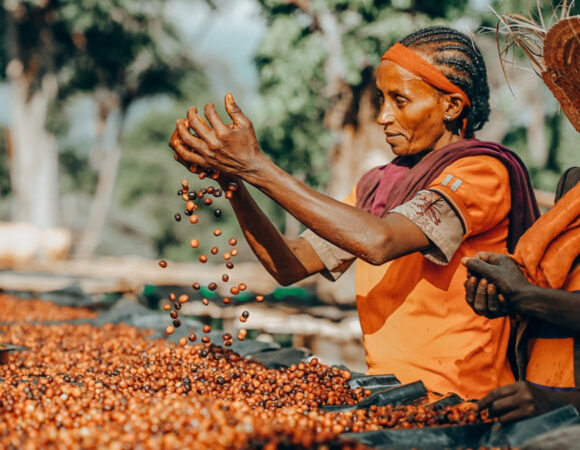
– Ethiopia is famous for growing some of the best coffee in the world. Coffee was discovered first in Ethiopia! The story goes that a goat herder long ago noticed his flock’s ‘flocked’ to a specific bush, and so he tried some of this fruit for himself. The rest of his day’s herding was notably more efficient – and now we have iced vanilla oat decaf frappucinos,
Festivals
– Ethiopia knows how to party. Timket is the biggest festival, but there is never a shortage of celebration, any time of year.
Vegetarian friendly
– Ethiopian cuisine is fantastic for non meat-eaters, thanks to a major branch of Christianity popular in Ethiopia forbidding it. Spicy vegan stews, injera and delicious wat. What’s wat? One way to find out…
13 Months in a Year
– Ethiopia is the only Christian country that still follows the Julian calendar, meaning it is seven years and eight months behind the rest of the Christian World! Thus, the Ethiopian calendar consists of 13 months: 12 months of 30 days and another month of five (or six days in leap years) days duration.
Also worth knowing, Ethiopians measure time in cycles of 12 hours starting when the sun rises at 6 a.m.
Climate
– Throughout most of the country there are two seasons: the dry season prevails from October through May; the wet season runs from June to September. Temperate in the highlands; hot in the lowlands.
Land: Ethiopia, as large as France and Spain combined, has an area of 1,112,000 square kilometers. About 65 percent is presently cultivated. Cities: Capital–Addis Ababa (pop. 5 million). Other cities–Dire Dawa (237,000), Nazareth (189,000), Gondar (163,000), Dessie (142,000), Mekele (141,000), Bahir Dar (140,000), Jimma (132,000), Awassa (104,000). Terrain: High plateau, mountains, dry lowland plains.
Topography: Ethiopia has an elevated central plateau varying in height between 2,000 and 3,000 meters. In the north and center of the country there are some mountains whose peaks rise over 4,000 meters. The most famous Ethiopian river is the Blue Nile (or Abbay), which runs a distance of 1,450 kilometers from its source in Lake Tana, to join the White Nile at Khartoum.
Economy: About 85 percent of the populations earn their living from the land, mainly as subsistence farmers. Agriculture is the backbone of the national economy and the principal exports from the sector are coffee, chat, oil seeds, pulses, flowers, vegetables, sugar and foodstuffs for animals. There is also thriving livestock sector, exporting cattle on the hoof and hides of skins.
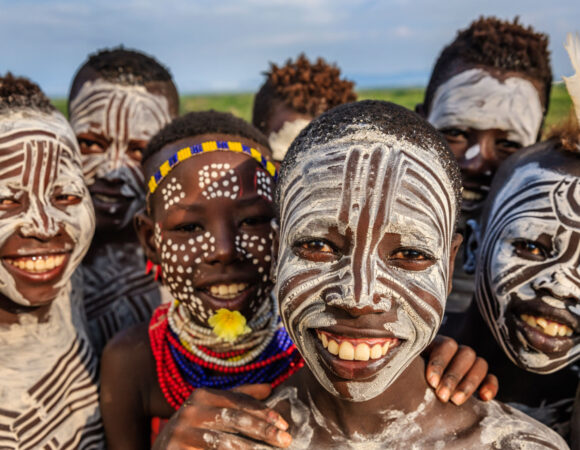
People: Ethiopia’s population is estimated around 77 million. Ethiopia is composed of about 83 ethnic groups. Based on the language they speak, they can be divided into Semitic, Cushitic, Nilotic and Omotic stocks. Annual growth rate: 2.7%. Ethnic groups (est.): Oromo 40%, Amhara 25%, Tigre 7%, Somali 6%, Sidama 9%, Gurage 2%, Wolaita 4%, Afar 4%, other nationalities 3%.
Wildlife
Wildlife
Wildlife
Sightseeing
Traveling
Education: Years compulsory–none. Attendance (elementary) 57%. Literacy–35%.
Work force
Agriculture–80%. Industry and commerce–20%.
Communication
Telephone, Tele fax, Internet, e-mail and postal facilities are available in the country. Internet services are available in major cities and towns only. The international dialing code for Ethiopia is +251.
Airport
The main Airport is Bole International Airport in Addis Ababa. It has various international connections. Domestic flights are also available to various regions of the country. The Historic route has daily flights from Addis Ababa, in the sites as Bahir Dar, Gondar, Lalibela, Axum and Dire Dawa South (Arbaminch South-west some cities are also connected (Jimma, and Gambella).